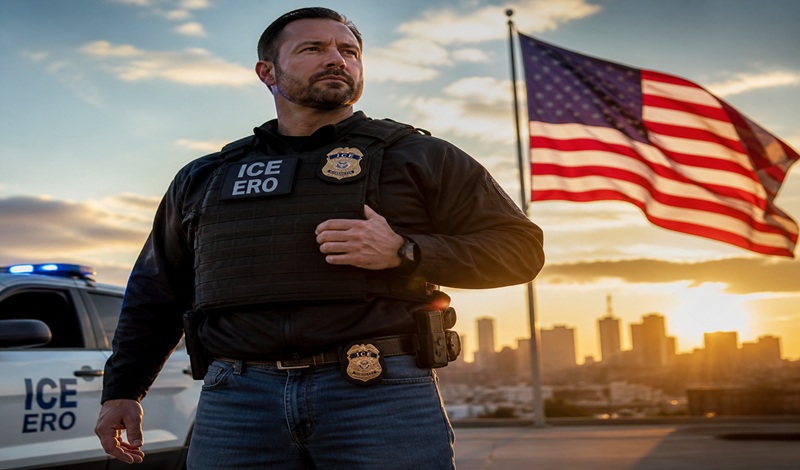
INDIANAPOLIS, May 6, 2026 — In February, ICE Enforcement and Removal Operations agent Gregory Donnell Morgan Jr. was working in Minneapolis, a city that had, in the weeks prior, become a crucible of open hostility toward federal immigration officers, where activists organized to track, follow, and engage agents in the field, sharing vehicle locations and movements in real time, and where political leaders had publicly demanded that ICE agents “get the ___ out”. Against that backdrop, one marked by mass violent protests, coordinated “observer” patrols shadowing federal vehicles, and an atmosphere in which agents were being surveilled and impeded, Morgan encountered a vehicle that cut into his path as he traveled along the shoulder. In that charged moment, with the line between traffic encounters and targeted attacks blurred by the climate around him, Morgan reacted as a federal officer trained to mitigate escalation: he drew his service weapon. He attempted to assert his authority, believing he faced not a routine roadway incident, but a potential threat consistent with the tactics being deployed against ICE agents throughout Minneapolis at that very moment.
For those actions taken in a rapidly evolving, high-pressure encounter requiring split-second decision-making, he has been criminally charged by the local prosecutor.
This case is not about a traffic incident on a Minnesota highway. It is about whether federal law enforcement officers can carry out the duties assigned to them by the United States government without fear for their lives or fear of politically motivated prosecution by local officials hostile to their mission.
When a vehicle cuts off a federal agent, when that vehicle may be part of a pattern of interference, surveillance, or even attack, the question is not whether an agent should be passive. The question is whether he can afford to be passive.
Agent Morgan’s actions must be viewed through the lens of reasonableness under those conditions. A reasonable officer, aware of the hostility surrounding him, aware of the absence of local support, aware of the documented practice of civilians following and attacking ICE agents, could and should perceive a threat where others, not under those circumstances, might not.
And what of the prosecutor?
County Attorney of Hennepin County, Minnesota, Mary Moriarty has built a record not of impartial enforcement, but of ideological opposition to ICE itself. Her policy positions, her affiliations, and the political forces behind her rise to elected office all point in one direction: toward confrontation with law enforcement. This prosecution bears the unmistakable imprint of that agenda.
When local prosecutors criminalize split-second decisions made under pressure, the result is not accountability; it is paralysis. Agents hesitate. Operations falter. The rule of law erodes.
The Department of Justice must not allow this precedent to stand.
We call upon the Attorney General to:
Assert federal jurisdiction and remove this case from state court.
Investigate whether this prosecution constitutes unlawful interference with federal operations.
Issue clear guidance ensuring that federal agents nationwide are protected from politically motivated prosecutions.
The stakes are not confined to Minnesota. They extend to every jurisdiction where federal law enforcement operates under the shadow of local hostility.
As we know from the current wave of political prosecutions of local police officers, society cannot function when its laws are enforced selectively, its officers are prosecuted for doing their duty, and radical local prosecutors veto law enforcement with criminal prosecution.
The National Police Association (NPA) is a 501(c)3 non-profit fighting for law enforcement through education, advocacy, and the courts. For more information, visit NationalPolice.org.
###